
Choosing the right communication equipment is important for businesses that depend on fast, reliable communication. Security companies, warehouses, construction teams, transportation services, hotels, and retail operations all need effective ways to keep employees connected.
Two common options are UHF two-way radios and 4G PoC radios. Although both support push-to-talk communication, they use different technologies and offer different advantages.
UHF radios communicate directly through radio frequencies, while 4G PoC radios use cellular networks and Push-to-Talk over Cellular technology. Understanding these differences can help businesses choose the right communication solution for their teams, operating environments, and budgets.
In this guide, MOYSAR.NET explains how UHF and 4G PoC radios work, compares their key features, and discusses which option may be better for different business applications.
1. What Is a UHF Two-Way Radio?
UHF stands for Ultra High Frequency. In professional two-way radio communication, UHF generally refers to frequencies between 300 MHz and 3 GHz, although commercial radio systems typically use specific frequency allocations within this range.
A UHF two-way radio transmits and receives voice signals over an assigned radio frequency. Depending on the system, radios may communicate directly with each other or use a repeater to extend coverage.
Many professional Motorola two-way radios support UHF configurations and are widely used in commercial environments.
Key Features of UHF Radios
- Direct communication: Radios can communicate without a cellular network when configured for direct radio-to-radio operation.
- Fast push-to-talk: Users can generally communicate with a simple button press.
- Local coverage: Suitable for facilities, warehouses, construction sites, hotels, and other defined operating areas.
- Flexible system design: Direct communication, repeaters, and other radio infrastructure can be used depending on coverage requirements.
- Accessory support: Compatible batteries, antennas, chargers, belt clips, earpieces, and remote speaker microphones help maintain equipment.
UHF radios are particularly useful when teams need dependable communication within a defined area and do not want routine communications to depend on a public cellular network.
However, actual coverage depends on transmit power, antenna performance, terrain, building materials, interference, and whether repeaters are installed.
2. What Is a 4G PoC Radio?
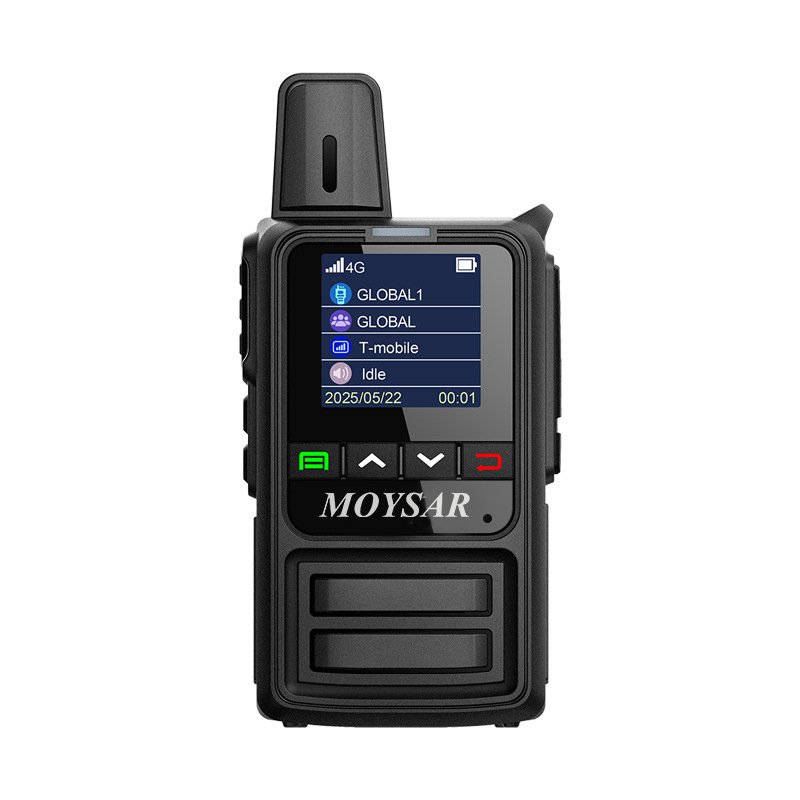
PoC stands for Push-to-Talk over Cellular. A 4G PoC radio uses a cellular data connection, such as 4G LTE, to transmit voice between users through a PoC platform or service.
Unlike a conventional UHF radio operating on a shared or assigned radio frequency, a PoC device typically communicates through cellular infrastructure and a server-based service.
Some PoC devices look similar to traditional walkie-talkies, with a physical push-to-talk button, a loud speaker, and a rugged handheld design. Others resemble smartphones with dedicated communication features.
Key Features of 4G PoC Radios
- Wide-area communication: Users can communicate across cities or regions when supported by cellular coverage and the service.
- No conventional local repeater required: Communication relies on the cellular network rather than a privately deployed UHF repeater system.
- Group communication: Many PoC platforms support talk groups and dispatch functions.
- Fleet management features: Depending on the service, features may include GPS location, dispatch consoles, recording, and device management.
- Subscription considerations: Service plans or platform fees may apply.
A 4G PoC radio can be a good choice for distributed teams that work across large geographic areas. However, its communication capabilities depend on network coverage, service availability, and the PoC platform being used.
3. UHF Radio vs. 4G PoC Radio: Key Differences
The main difference is how each system carries voice communication. UHF radios use radio-frequency transmission, while 4G PoC radios use cellular data networks.
| Feature | UHF Two-Way Radio | 4G PoC Radio |
| Communication technology | UHF radio frequencies | Cellular data and PoC service |
| Network dependency | Can operate directly without cellular service | Requires compatible cellular coverage and service |
| Coverage | Local area; can be extended with repeaters | Potentially wide-area wherever supported cellular service is available |
| Communication delay | Typically very low in direct radio operation | Depends on cellular network and PoC platform |
| Infrastructure | May need licensed frequencies or repeaters | Uses cellular infrastructure and a PoC platform |
| Ongoing costs | May have licensing, maintenance, and infrastructure costs | May have SIM, data, and platform subscription fees |
| Group communication | Supported by many conventional and digital systems | Often supports configurable talk groups |
| GPS and dispatch | Depends on radio model and system | Often available through supported PoC services |
| Operation without network | Direct-mode UHF communication can continue within range | Usually unavailable if no usable cellular connection or alternative network exists |
| Best suited for | Local teams and defined operating areas | Distributed teams and wide-area coordination |
Actual performance varies by radio model, network configuration, and operating environment. Neither technology is automatically the best choice for every business.
4. Which Radio Has Better Coverage?
Coverage is one of the most important factors when choosing between UHF and 4G PoC radios.
UHF Radio Coverage
UHF radios are often well suited to indoor environments, commercial buildings, warehouses, hotels, and facilities where teams operate within a defined area.
However, walls, metal structures, reinforced concrete, and other obstacles can affect signal propagation. If a facility is large or contains radio dead zones, a properly designed repeater system may be necessary.
A major advantage is that direct-mode UHF communication can continue without a cellular connection, provided the radios are within usable range and correctly configured.
4G PoC Radio Coverage
4G PoC radios can connect users across much larger distances than a typical direct-mode handheld radio, provided the relevant cellular network and PoC service are available.
For example, a security supervisor in one city may communicate with a team in another city through the same PoC talk group.
However, cellular coverage is not universal. Remote areas, underground locations, some industrial buildings, network outages, or service interruptions can affect communication.
Practical recommendation: Choose UHF when your team mainly operates within a defined site and needs local radio communication. Consider 4G PoC when employees are spread across multiple locations and wide-area communication is essential.
5. Which Is More Cost-Effective?
The total cost of ownership depends on the number of users, the operating area, infrastructure requirements, and expected service life.
UHF Radio Costs
A UHF system may involve:
Radio purchase costs
Batteries and chargers
Antennas and audio accessories
Frequency licensing where required
Repeater installation and maintenance, if needed
Spare parts and repairs
For a small team operating in one building or facility, a simple UHF system may be economical. A larger private radio system may require more investment in infrastructure.
4G PoC Radio Costs
A PoC system may involve:
PoC device purchase costs
SIM cards and cellular service
Platform or subscription fees
Dispatch software, if required
Batteries, chargers, and replacement accessories
Device management and technical support
PoC can reduce the need to deploy private radio repeaters, but recurring service charges can add up across a large fleet.
When comparing options, calculate the expected costs over several years instead of comparing only the initial device prices.
6. Accessories and Maintenance: What Should Buyers Consider?
Regardless of the communication technology, accessories play an important role in day-to-day reliability.
For businesses using conventional Motorola two-way radios, common replacement accessories include:
- Batteries: Replacement batteries help maintain operating time during long shifts.
- Antennas: Correct antennas are essential for the radio’s frequency band and configuration.
- Belt clips: Replacement clips keep handheld radios secure and accessible.
- Earpieces and headsets: Useful for discreet communication in security, hospitality, and retail.
- Remote speaker microphones: Allow users to communicate without removing the radio from their belt or carry case.
- Chargers: Single-unit and multi-unit chargers support daily charging routines.
- Carry cases: Help protect equipment and make it easier to carry.
For repair shops, distributors, and radio resellers, maintaining an organized inventory of frequently requested replacement parts can reduce repair delays and improve customer service.
For PoC radios, accessories may include batteries, charging cradles, belt clips, headsets, and remote microphones. However, physical connectors, electrical specifications, and accessory compatibility vary by manufacturer and model. Do not assume that an accessory designed for a conventional Motorola UHF radio will fit a PoC device.
7. Which Option Is Better for Different Industries?
The right choice depends on where employees work and how they communicate.
Security Companies
UHF radios can be effective for security teams working within a building, campus, shopping center, or defined site. PoC may be more suitable when supervisors and mobile teams need to communicate across several cities or locations.
Warehouses and Manufacturing
UHF radios are often a practical option for warehouse operations and factory-floor coordination, particularly when cellular service is unreliable inside the facility. A site survey can help identify whether repeaters are needed.
Transportation and Logistics
PoC radios can be attractive for logistics businesses coordinating vehicles, dispatchers, and staff across wide geographic areas. UHF may still be useful for local depot operations or areas where cellular coverage is limited.
Hotels and Retail
UHF radios are suitable for many on-site teams that need quick, local communication. PoC may be useful for businesses coordinating multiple branches or geographically separated locations.
Construction and Field Services
The choice depends on the job site. UHF may work well with a properly planned local radio system, while PoC can help teams communicate across different sites where cellular coverage is available.
8. Can Businesses Use UHF and 4G PoC Radios Together?
Yes. Some organizations use both technologies to meet different communication needs.
For example, a company may use UHF radios for staff working inside a warehouse and PoC radios for regional supervisors or drivers working across multiple locations.
However, conventional UHF radios and PoC devices do not automatically communicate with each other. Interconnection may require a compatible gateway, dispatch system, or other integration solution. Compatibility and system design should be verified before deployment.
A hybrid approach can provide local radio communication and wide-area coordination, but businesses should also consider training, device management, and how communication will work during network outages.
9. How to Choose the Right Communication Solution
Before buying UHF or 4G PoC radios, ask the following questions:
- Where will the radios be used? A single building has different requirements from a regional fleet.
- Is cellular coverage reliable? Test coverage in actual work areas, including basements and industrial buildings.
- How many users need to communicate? Consider talk groups, dispatch, and the need to connect multiple sites.
- What is the total cost? Include devices, accessories, infrastructure, service fees, and maintenance.
- What happens during an outage? Determine whether your team needs direct-mode communication or a backup system.
- Which accessories are compatible? Check the exact model, frequency, connector, battery, and charger specifications.
- Are licenses required? Confirm applicable radio-frequency regulations and licensing requirements in your country.
Answering these questions helps businesses choose equipment based on operational needs rather than marketing claims alone.
10. MOYSAR.NET: Replacement Accessories for Professional Two-Way Radios
MOYSAR.NET is an independent third-party accessories website focused on compatible Motorola two-way radio replacement parts and accessories.
We serve radio repair shops, distributors, resellers, and commercial users seeking practical sourcing options for everyday radio maintenance.
Our content and product focus includes categories such as batteries, antennas, belt clips, audio accessories, and other commonly replaced components for supported Motorola radio models.
If your business operates conventional Motorola UHF radios, choosing the correct replacement accessories can help maintain equipment usability and manage maintenance costs. Always verify compatibility with the exact radio model before ordering.
When comparing affordable compatible Motorola radio accessories, buyers should consider not only price but also product specifications, fit, quality, supplier support, and any requirements related to safety or environmental protection.
Conclusion
The main difference between a UHF radio and a 4G PoC radio is the communication network they use.
UHF radios can provide fast, direct communication within a local operating area without depending on cellular coverage. They are often a strong choice for warehouses, construction sites, hotels, security teams, and other businesses that need reliable on-site communication.
4G PoC radios use cellular networks to connect users over wider geographic areas. They can be particularly useful for transportation, logistics, distributed security teams, and organizations that need centralized dispatch or GPS-based fleet coordination.
Neither technology is universally better. The right solution depends on coverage, infrastructure, recurring costs, operating conditions, and business requirements.
For organizations using Motorola two-way radios, reliable replacement accessories are also essential to keeping equipment ready for daily use. MOYSAR.NET helps buyers explore compatible Motorola radio accessories for maintenance and replacement needs.
Choose the communication system that fits your workflow, and verify every accessory’s compatibility before purchasing.